
The Benefits of Puzzles for Toddlers

Hey there, awesome parents and curious caregivers! Today, let’s talk about something that’s both fun and incredibly beneficial for your little ones: puzzles! Yes, those colorful pieces that scatter across your floor are more than just playthings. They are developmental goldmines! So, let’s piece together the benefits of puzzles for toddlers and discover why they should be a staple in your child’s playtime.
The form you have selected does not exist.
1. Hand-Eye Coordination
Working on puzzles helps toddlers develop this crucial skill, where the eyes see the puzzle, the brain figures out what needs to happen, and the hands execute the action. This ability is important not just for puzzles but for almost everything—from eating with a spoon to catching a ball.
When toddlers work on puzzles, they see the puzzle pieces, and their brains quickly analyze and process where each piece might fit within the puzzle. Then, they must coordinate their hand movements to place the pieces precisely in the right spot. This process involves fine motor skills and visual perception working hand in hand.
- Daily Activities: The hand-eye coordination they practice with puzzles translates directly into everyday tasks. For instance, using a spoon requires seeing the food, estimating its distance and location, and coordinating their hand movements to bring the spoon to their mouth successfully.
- Play: This skill is also critical in play situations, like stacking blocks, playing catch with a ball, or drawing. Each of these activities requires the eyes and hands to work together smoothly and efficiently.
- Learning Tools: In educational settings, good hand-eye coordination helps toddlers engage more effectively with other learning tools and activities, such as cutting with scissors, using a computer mouse, or interacting with touch-screen devices. Each of these activities builds from the fundamental skills practiced with puzzles.
By enhancing their hand-eye coordination through puzzle play, toddlers are not only better equipped to handle immediate tasks but are also laying the groundwork for more complex skills they will need throughout their education and daily life.
2. Cognitive Skills
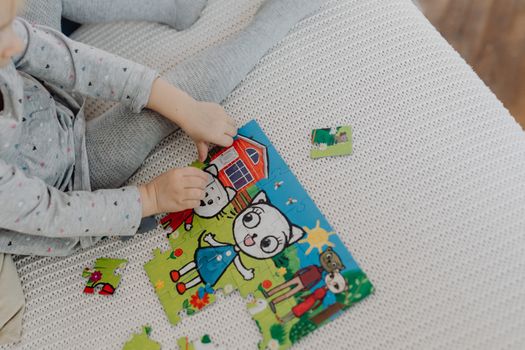
Puzzles challenge the mind and help little ones develop understanding through sorting, matching, and choosing. This encompasses skills like recognizing shapes, remembering images, and understanding simple to complex concepts, which are fundamental in learning numbers, letters, and eventually reading and mathematical concepts.
Puzzles involve various cognitive skills that are vital for early development. They require toddlers to recognize different shapes, colors, and patterns and figure out where each piece fits into a puzzle. This not only involves visual recognition but also strategic thinking as toddlers decide which pieces might fit together.
- Shape Recognition: Identifying the shape of puzzle pieces and understanding where they fit is foundational for recognizing shapes in real-world objects.
- Memory: Toddlers enhance their memory by remembering specific pieces and where they attempted to place them, learning from unsuccessful tries, and applying that knowledge as they proceed.
- Problem Solving: Deciding how to approach solving a puzzle and adjusting strategies when something doesn’t work teaches basic problem-solving skills.
- Concept Learning: Puzzles can introduce and reinforce new concepts such as size, shape, and spatial relationships. Understanding these concepts is essential for the development of mathematical and language skills.
- Numeracy: As they sort and match pieces, toddlers are laying the groundwork for understanding numbers and quantities. Puzzles often involve counting pieces or matching numbers, which naturally integrates mathematical thinking.
- Literacy: Puzzles with letters or words help in letter recognition and reading skills. By piecing together letters or simple words, toddlers begin to understand the building blocks of reading.
- General Knowledge: Themed puzzles (like those with animals, vehicles, or maps) help expand a toddler’s knowledge base and vocabulary related to specific subjects.
In essence, engaging with puzzles not only challenges toddlers’ brains, making the learning process dynamic and enjoyable, but also equips them with essential cognitive skills that are foundational for academic success and everyday problem-solving.
3. Fine Motor Skills
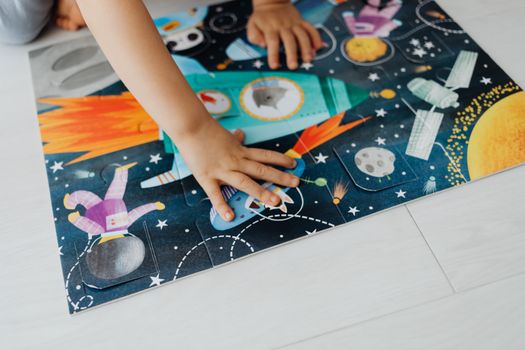
Manipulating small puzzle pieces requires precise movements, which enhance dexterity and motor control. Regular practice with puzzles translates to better abilities in tasks such as drawing, writing, and fastening clothing.
When toddlers manipulate smaller pieces, they are effectively training their small hand muscles and improving their dexterity. Each action of picking up, grasping, and placing puzzle pieces involves a series of small, controlled movements that enhance their fine motor skill development.
- Dexterity: Handling small puzzle pieces helps toddlers develop their finger strength and control, which is necessary for more precise tasks.
- Hand-Eye Coordination: As they place each piece in its spot, toddlers are practicing the coordination of their eye movement with hand movement, which is crucial for fine motor precision.
- Pincer Grip: Picking up puzzle pieces requires the use of the thumb and one or more fingers to pinch and lift, which is the same grip used for holding writing tools. This grip is essential for writing and drawing as they grow older.
- Writing and Drawing: The skills used in manipulating puzzle pieces are directly transferable to holding and controlling a pencil or crayon, helping toddlers when they begin to write and draw.
- Dressing Skills: Fine motor control is also important for self-care skills such as buttoning shirts, zipping up jackets, or tying shoelaces.
- Eating Utensils: Using forks and spoons requires similar dexterity and coordination, which puzzles help to develop.
By engaging with puzzles, toddlers not only have fun but also work on critical physical skills that will aid them in more complex tasks as they grow, ensuring that they have the fine motor control necessary for academic tasks and everyday activities. This foundational development is a stepping stone to greater independence and competence in a variety of skills throughout their lives.
4. Problem-Solving Skills
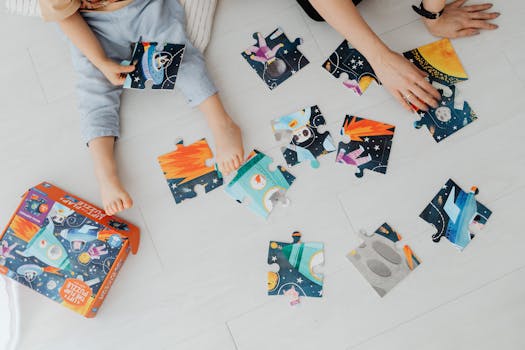
Puzzles provide a clear goal but achieving it involves problem-solving. Toddlers learn to strategize by deciding which piece to try and where to place it, teaching them perseverance and patience as they work through challenges.
Puzzles naturally teach toddlers the art of solving problems. Each puzzle piece presents a mini-challenge, where toddlers must figure out where it belongs in the larger picture. This task requires them to assess, hypothesize, and test their ideas.
- Strategic Thinking: Toddlers begin to understand that certain strategies may help them complete the puzzle faster, like finding all the edge pieces first or grouping pieces by color or pattern.
- Trial and Error: Puzzles are a safe and engaging way for toddlers to experiment and learn from mistakes. They quickly realize that if a piece doesn’t fit, they need to try another one, teaching them the fundamental process of trial and error.
- Decision Making: Each choice a toddler makes with a puzzle piece teaches them to make decisions and observe the outcomes, which is the basis of problem-solving.
- Perseverance and Patience: Puzzles can be challenging, and completing them requires persistence. Toddlers learn to work through frustration and keep trying until they succeed, which is a valuable life skill.
- Building Cognitive Flexibility: Facing and overcoming the challenges puzzles present help build cognitive flexibility—adapting thoughts and behaviors in response to changing environments and obstacles.
- Enhancing Focus and Concentration: Solving puzzles requires sustained attention, which improves overall concentration skills and the ability to focus on tasks.
- Emotional Resilience: Learning to cope with minor setbacks as they attempt different solutions helps build emotional resilience, enabling toddlers to handle bigger challenges as they grow.
Puzzles not only entertain but also equip toddlers with the critical thinking and problem-solving skills they’ll use throughout their education and in daily life. Each puzzle solved builds more than just a picture—it builds a foundation for effective thinking and problem-solving capabilities.
5. Emotional Skills
Puzzles are a gentle and effective way to help toddlers develop crucial emotional skills. Here’s how they contribute:
- Patience and Persistence: Puzzles often require multiple attempts to find where a piece fits, teaching toddlers the virtue of patience and the need to persist despite challenges. This helps in developing resilience and the ability to cope with frustration.
- Self-Esteem and Confidence: Completing a puzzle provides a sense of accomplishment and boosts self-esteem. Every time a toddler fits a piece correctly, it’s a small success that encourages them to tackle more difficult tasks, building their confidence along the way.
- Mood Regulation: Engaging in puzzles can be a calming activity for many toddlers. The focus required helps them learn to manage their emotions and can serve as a positive outlet for energy, reducing tantrums and mood swings.
- Achievement and Satisfaction: The joy and satisfaction that come from solving a puzzle are invaluable. These feelings of achievement help toddlers develop a positive association with learning and problem-solving.
Jigsaw Puzzles can also help a child’s development in the following ways:
- Spatial Awareness – By manipulating different shapes and fitting them into spaces, toddlers develop an understanding of spatial relationships. This helps them learn concepts like in, out, under, next to, and more, which are crucial for mathematical reasoning.
- Social Skills – When puzzles are done in groups, toddlers get the chance to interact, share, take turns, and even lead. This fosters empathy and cooperative play, as well as verbal skills as they talk about what they are doing and negotiate with peers.
- Memory Skills – Remembering the shape, color, or pattern of a piece and where it fits in the puzzle boosts a toddler’s memory retention. Each puzzle session strengthens short-term and visual memory, contributing to overall learning readiness.
- Critical Thinking – Puzzles require toddlers to make choices and face the consequences of those choices. They learn to evaluate outcomes, which enhances their decision-making skills and ability to think critically and logically.
- Visual Perception – Identifying differences and similarities in puzzle pieces helps toddlers develop visual perceptual skills. These skills are vital for academic tasks such as reading, where distinguishing letters and words quickly becomes necessary.
- Gross Motor Skills – For larger floor puzzles, toddlers engage their whole body. This not only makes solving puzzles fun but also helps in the development of larger muscle groups. Movements like stretching to place a piece help improve coordination and balance.
Different Types Of Puzzles
Puzzles come in a variety of types, each offering unique benefits and challenges. Here’s a look at some popular kinds of puzzles that are great for toddlers and older children alike:
1. Jigsaw Puzzles
These are the classic puzzles that consist of interlocking pieces, each with a small part of a picture on it. When put together, they form a complete image. Jigsaw puzzles range from simple versions with just a few large pieces to complex ones with hundreds of pieces.
2. Wooden Peg Puzzles
These puzzles are usually made of wood and feature small pegs on each piece, making them easy for little hands to grasp. They are often themed with letters, numbers, animals, or common objects, helping toddlers learn basic concepts while practicing fine motor skills.
3. Knob Puzzles
Similar to peg puzzles but with larger knobs, these are perfect for very young toddlers. The large knobs are easier for children who are still developing their pincer grip and coordination.
4. Floor Puzzles
These are large puzzles that are assembled on the floor. They typically have big pieces, which are easier for toddlers to handle. Floor puzzles are excellent for developing gross motor skills and spatial awareness as children move around to put the pieces together.
5. Puzzle Boards
Puzzle boards often have fixed pieces that slot into corresponding spaces on a board. These can depict everything from maps to animal scenes and are great for teaching spatial relationships and fine motor coordination.
6. 3D Puzzles
These puzzles go beyond flat images to create three-dimensional structures like buildings, vehicles, or globes. They are more challenging and suitable for older toddlers and children, helping develop spatial reasoning and visualization skills.
7. Shape Sorters
While not puzzles in the traditional sense, shape sorters require toddlers to recognize different shapes and fit them into the correct holes, much like a puzzle. They are fantastic for early problem solving.
FAQ About The Benefits of Puzzles For Toddlers
Why are puzzles good for toddlers?
Puzzles are excellent for toddlers because they provide a range of developmental benefits in a fun and engaging way. They help improve cognitive and physical skills while also enhancing fine motor development and problem-solving abilities. Additionally, puzzles can be a social activity, promoting cooperative play and communication skills when played with others.
What skills do puzzles teach toddlers?
Puzzles teach toddlers several important skills:
- Cognitive skills: Recognizing shapes, colors, and patterns.
- Fine motor skills: Developing dexterity and hand-eye coordination.
- Problem-solving skills: Learning to think logically and strategically.
- Spatial awareness: Understanding how different pieces fit together.
- Social skills: Sharing, cooperating, and communicating when playing with others.
- Memory enhancement: Strengthening visual and short-term memory.
- Critical thinking: Making decisions and evaluating outcomes.
- Visual perception: Distinguishing between different pieces based on visual cues.
What are the benefits of puzzles?
The benefits of puzzles for toddlers are extensive, encompassing educational, developmental, and social aspects. They include:
- Enhancing concentration and attention to detail.
- Building confidence and a sense of achievement upon completion.
- Improving visual-spatial reasoning, important for academic skills like math and science.
- Offering a hands-on way to learn through play, which is vital in early childhood education.
- Encouraging persistence and patience as they work through challenges.
Why are knob puzzles good for toddlers?
Knob puzzles are particularly good for toddlers because they are designed with large, easy-to-grasp knobs that make it simpler for little hands to handle and manipulate the pieces. These types of puzzles help toddlers develop pincer grasp skills, which are crucial for writing and handling small objects. Knob puzzles also make it easier for toddlers to learn the action of placing pieces exactly where they belong, providing an excellent introduction to puzzles by simplifying the manipulation of pieces, thus reducing frustration and enhancing enjoyment.

Conclusion: Puzzles – A Cornerstone of Toddler Development
So there you have it! The benefits of puzzles for toddlers are as varied as the puzzles themselves. They offer an enriching experience that touches upon cognitive development, fine motor skills, social and emotional growth, language development, patience, persistence, and creativity. Most importantly, they are a source of joy and discovery for your little ones.
Remember, the best puzzles for toddlers are those that match their developmental stage and interests. Always ensure that the puzzles are age-appropriate and safe. Now, let’s get those puzzle pieces out and watch our tiny tots learn, grow, and have a blast!


